If a listing for ten acres outside Paso Robles mentions "productive well, no HOA," what has actually been confirmed? The well exists. It pumps. Beyond that, the sentence tells you almost nothing about whether the water underneath that parcel is yours to use on the terms you're assuming, or what it might cost you to keep using it.
That distinction used to be mostly theoretical for buyers outside the working vineyard trade. In 2026 it stopped being theoretical. Over roughly twelve months, a fee proposal by the agency that manages the Paso Robles Groundwater Basin was rejected by majority protest, and a groundwater sustainability fee was later adopted under a different section of state law. In the same stretch, a lawsuit that had been running for more than twelve years over who actually holds the right to pump from the basin finally reached a verdict. A well on a listing sheet describes infrastructure. It says nothing about which of those two stories the parcel underneath it is caught up in.
A Well Is Plumbing. A Water Right Is Something Else
The Paso Robles Groundwater Basin, technically the Paso Robles Area Subbasin of the Salinas Valley Groundwater Basin, covers roughly 436,000 acres bounded by the Santa Lucia Range to the west, the La Panza Range to the south, and the Temblor and Diablo Ranges to the east. The state's Department of Water Resources classifies it as critically overdrafted, meaning more water has been coming out than nature puts back in. Under California's Sustainable Groundwater Management Act, the agencies responsible for the basin have to bring it into balance by 2040.
That responsibility falls to the Paso Robles Area Groundwater Authority, a joint powers agency made up of the City of Paso Robles, the County of San Luis Obispo, the Shandon-San Juan Water District, and the Estrella-El Pomar-Creston Water District. PRAGA doesn't own the water. It monitors it, reports on it, and increasingly, it charges for it. That last part is where the ground moved twice in one year.
The two actions addressed the same underlying need, but proceeded under different parts of the state constitution.
The 2025 Proposal and the 2026 Fee
In August 2025, PRAGA put a property-based fee to a vote under Proposition 218, the state law that lets property owners kill certain fees by majority protest. The ask was substantial, around $3 million to fund monitoring and compliance work, according to CalCoast News. Landowners organized and blocked it under Prop 218, so the proposal was not adopted.
In May 2026, PRAGA released a draft rate and fee study for a new groundwater sustainability fee for fiscal year 2026-2027, this time proceeding under Proposition 26 rather than Proposition 218. The board adopted it on May 27, 2026, at $22.90 per acre-foot of consumed groundwater, calculated against Water Year 2025 use (October 2024 through September 2025) and measured through satellite evapotranspiration data supplied by a technical consultant, Land IQ. The fee funds a $1,095,446 operating budget, smaller than the original 2025 ask, and it stuck.
The mechanical difference matters more than the dollar figure, and the notice process also differed.
Here's the timeline, condensed:
| Date | What happened |
|---|---|
| August 2025 | Landowners block a roughly $3 million PRAGA fee proposal under Prop 218 |
| May 7, 2026 | PRAGA releases a draft rate and fee study for a new FY 2026-2027 fee, this time under Prop 26 |
| May 27, 2026 | PRAGA board adopts the fee at $22.90 per acre-foot, funding a $1,095,446 budget |
| June 8, 2026 | Deadline for landowners to appeal their individual water-use calculations |
| August 2026 | A lawsuit lasting more than 12 years over basin pumping rights concludes |
A parcel that looked "clean" on water in early 2025, before any of this played out, may now carry an annual charge tied to how much it consumed the prior water year, calculated from satellite data.
A Second, Separate Fight Over Who Gets to Pump at All
While the fee question was working through PRAGA's board process, a different and older dispute was finishing in court. In 2013, San Luis Obispo County enacted what it called an emergency ordinance, capping landowners' pumping at a fixed amount rather than a flexible one tied to what they were actually irrigating. More than 800 property owners organized as a group called Protect Our Water Rights and pushed back, arguing the county was using the ordinance to erode water rights that California law and the state constitution already gave them as overlying landowners.
That fight ran for more than twelve years and five trials. It concluded in August 2026, and CalCoast News reported that four of the defendants secured the right to pump slightly more than 2,000 acre-feet a year, out of the basin's roughly 92,000 acre-foot safe annual yield.
Put the two stories together and the picture for a buyer gets clearer, not murkier: the basin is still being actively negotiated, in a courtroom and in a public agency's board meetings, at the same time. A property's water status in 2026 is not the same fact it was in 2023, and it may not be the same fact again in 2027.
What This Means When You're Comparing Properties
The countywide numbers don't carry any of this. As of August 2026, the median closing price across Paso Robles ran around $754,500 over a six-month window covering 342 tracked closings. That figure describes the center of the market. It says nothing about whether a specific rural parcel sits inside the mapped groundwater basin, what its Water Year 2025 consumption was, or whether the seller has an open appeal with PRAGA. Well yield, water rights, and basin district status are diligence items the closing price was never built to capture.
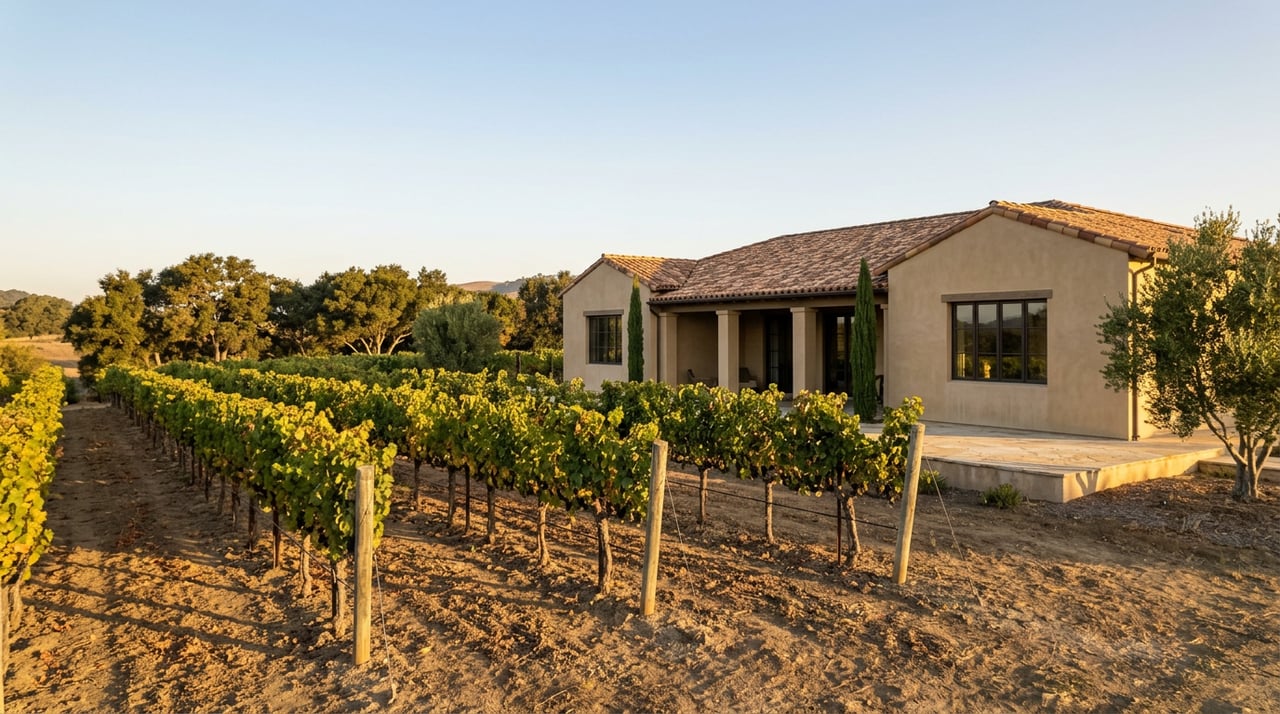
Where water status does show up is in how vineyard-scale properties actually trade. An 80-acre vineyard estate near Paso Robles, with about 71 planted acres and two residences, sold for $10.5 million in December 2025 after just nine days on the market, purchased by a neighboring owner who already understood the water picture. Larger working ranches in the area routinely list multiple wells and reservoirs as named features, not afterthoughts. When one 800-acre vineyard ranch changed hands recently, its listing specifically called out five wells and two reservoirs totaling about 73 acre-feet of storage. Buyers who already farm the region treat verified water infrastructure as a line item worth negotiating over, not a box to check.
That's the gap for a lifestyle or investment buyer coming from outside the area. The asking prices on rural land and vineyard parcels around Paso Robles vary widely, and water access is one of the biggest reasons why two properties at a similar price per acre can be worth very different amounts once you account for what each one can actually irrigate, and what it costs to do so.
Before writing an offer on rural or vineyard-adjacent acreage here, it's worth asking the seller or their agent for:
- Confirmation the parcel actually sits inside the mapped Paso Robles Groundwater Basin. Not every rural parcel in the area does, and status varies by district.
- A recent well flow or pump test, not just a statement that the well works.
- Water Year 2025 consumption figures if the seller has already been billed under PRAGA's new fee.
- Documentation of any shared wells, reservoirs, or riparian rights tied to the parcel.
- Whether the seller has an open or resolved appeal on file with PRAGA over their water-use calculation.
A Few Questions Worth Asking Early
Does every property in Paso Robles fall under PRAGA's fee? No. Only parcels located within the mapped groundwater basin are subject to it. Basin boundaries can be checked through San Luis Obispo County's groundwater sustainability program.
Does having a well mean I'll owe this fee? Not automatically. The fee is based on consumed groundwater use during a specific water year, measured by satellite data, not simply on whether a well exists. Buyers should ask sellers directly whether the property has been assessed and whether that assessment was appealed.
Water in Paso Robles wine country isn't a single fact you confirm once and move past. It's a relationship with an agency and, in some cases, a court record, and both of those kept changing in 2026. Anyone weighing a rural or vineyard-adjacent property here deserves a clear read on where a specific parcel actually stands, not just what the listing sheet says about the well.
If you're comparing acreage around Paso Robles and want help sorting out what a property's water status actually means for your plans, Sara Corliss can walk through it with you alongside the area's local vendor and inspection network. Schedule a Free Consultation to start.
This article is general information, not legal, tax or financial advice. Consult a qualified professional about your situation.